Match research
Centimorgans versus DNA percentage: two ways to describe sharing
Why cM and DNA percentages answer different questions, how conversions work, and why reported cM should remain the primary match measurement.
Updated 2026-09-13 · 6 min read · Genealogy & education only
Centimorgans are not a ruler
A centimorgan is a recombination unit. Roughly speaking, it describes how likely two points on a chromosome are to be separated when DNA is passed to the next generation. It is useful in genealogy because a matching segment’s cM length reflects inheritance history more directly than physical base-pair length.
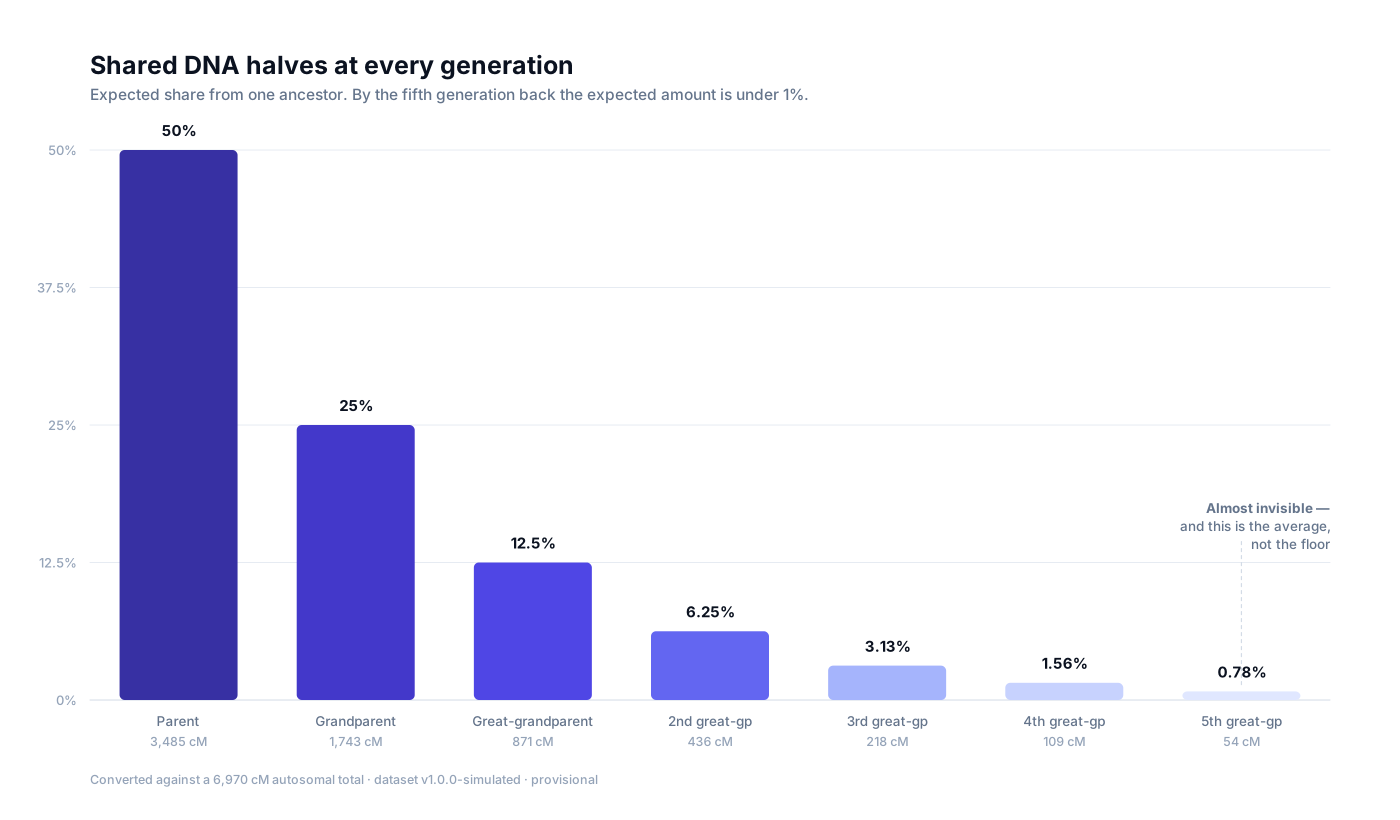
A percentage is a summary calculation. If a service reports 850 cM and a site uses an autosomal baseline around 6,800 cM, that works out to a value near one eighth. Change the baseline and the percentage changes slightly, even though the DNA match has not changed.
Why a clean conversion can still mislead
Testing companies can use different genetic maps, marker panels, thresholds, and segment filters. Two providers may report slightly different totals for the same pair of people. Rounding can also make a percentage look more certain than it is. For that reason, “12.5%” is useful as a teaching shorthand; “850 cM reported by this provider” is more useful research evidence.
Neither number names a relationship. Several relationship paths can share similar cM totals because recombination is random. A percentage conversion does not remove that overlap—it only changes the unit in which the same uncertainty is written.
Use the right unit for the question
Use total shared cM when comparing a match against relationship ranges, working through a shared-match cluster, or entering the DNADojo calculator. Use a percentage when explaining the broad expected share from a direct ancestor or when communicating a scale to a reader who does not use cM.
Keep the original total, provider, and date in your research notes. If you calculate a percentage, record the denominator. That small habit makes your work auditable and prevents an apparent disagreement when another source uses a different autosomal total.
What else could fit?
| Possibility | Why it can look similar | What to check |
|---|---|---|
| Total shared cM | It is the conventional unit used in relationship reference ranges and preserves the provider’s reported match measurement. | Record the value, provider, segment threshold, and date before comparing it with a range. |
| Autosomal DNA percentage | It makes the size of a match intuitive but depends on the autosomal total selected for the conversion. | State the denominator and keep the source cM total beside the percentage. |
| Physical base-pair length | It measures chromosome coordinates, while cM measures recombination distance; the two do not have one fixed conversion. | Use base pairs for location and cM for inherited-distance comparison. |
What to do next
- Start every match note with the exact total shared cM reported by the testing provider.
- Use the DNA Percentage Calculator only after selecting and recording its stated autosomal baseline.
- When comparing a relationship hypothesis, return to cM, age, segments, shared matches, and records rather than treating a percentage as extra evidence.
Questions people ask
Is 1 cM equal to 1% of DNA?
No. A centimorgan is a recombination-distance unit; a percentage is a portion of a selected autosomal total.
Why do different websites convert the same cM total to slightly different percentages?
They may use different autosomal totals, genetic maps, rounding rules, or platform assumptions.
Should I use cM or percentage to identify a DNA match?
Use the reported cM total for relationship research. A percentage can help explain scale but does not resolve overlapping relationship ranges.
Published September 17, 2026 · Reviewed against DNADojo dataset v1.0.0-simulated · Sources and limitations