Free calculator
Inheritance Calculator
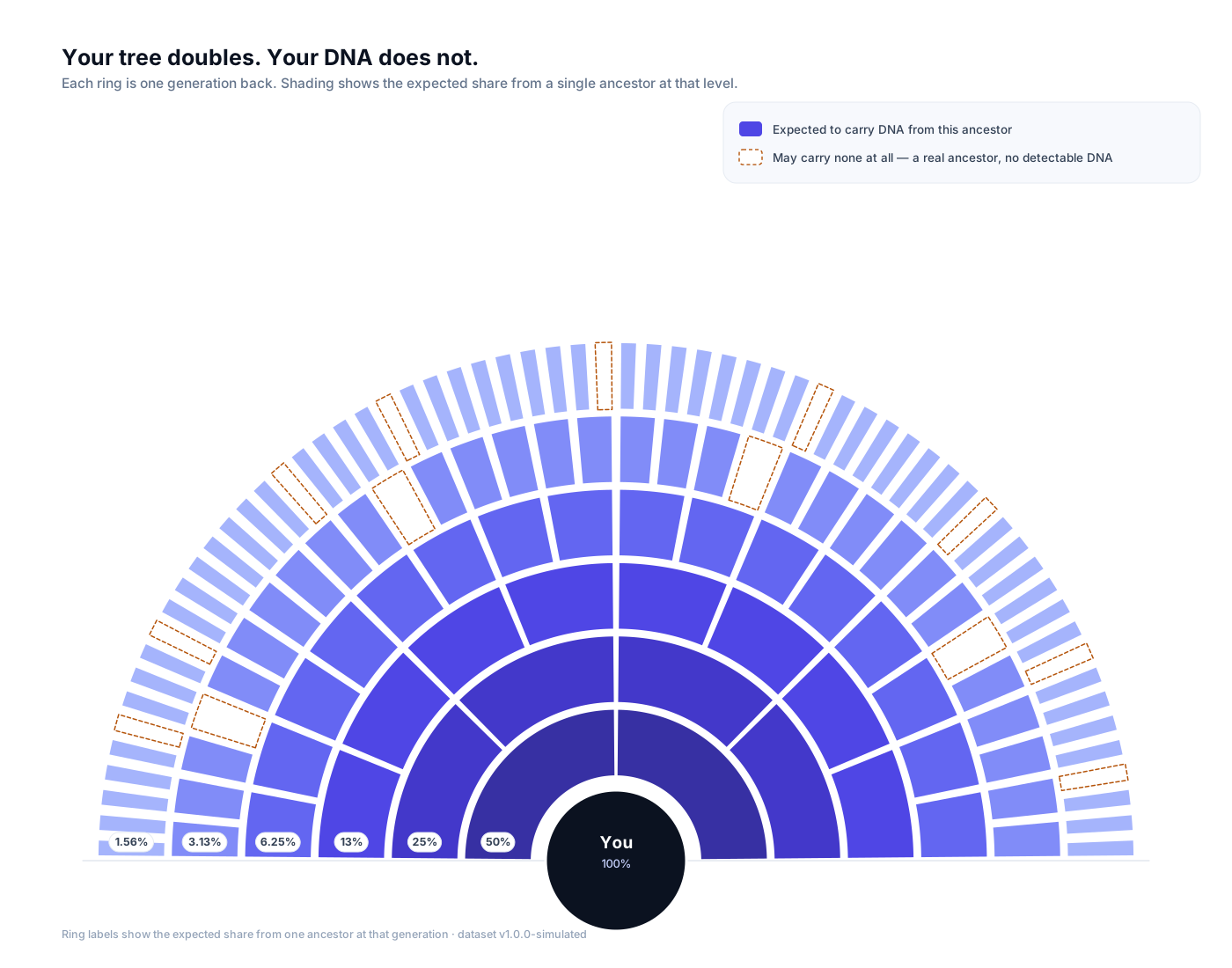
Pick how many generations back an ancestor sits and see the DNA you would expect to carry from them, the realistic spread, and the point where the trail goes cold.
Walk back up your tree
Deterministic · no AIThe full ladder
| Generation | Ancestor | Ancestors | Expected | Realistic cM | Dropout risk |
|---|---|---|---|---|---|
| 1 | Parent | 2 | 50.00% | 3,485–3,485 | none |
| 2 | Grandparent | 4 | 25.00% | 1,080–2,405 | none |
| 3 | Great-grandparent | 8 | 12.50% | 366–1,411 | low |
| 4 | 2nd great-grandparent | 16 | 6.25% | 122–828 | low |
| 5 | 3rd great-grandparent | 32 | 3.13% | 35–501 | moderate |
| 6 | 4th great-grandparent | 64 | 1.56% | 9–305 | high |
| 7 | 5th great-grandparent | 128 | 0.781% | 2–185 | very high |
| 8 | 6th great-grandparent | 256 | 0.391% | 0–109 | very high |
What to do about it
- Test the oldest generation you can, now. A grandparent's test recovers segments that are already lost to you.
- Test sideways. Aunts, uncles and first cousins carry different halves of the same grandparents.
- Stop expecting autosomal proof past about six generations. Use it to generate hypotheses, then prove them with records.
Common questions
Can I really carry none of a documented ancestor's DNA?
Yes. Autosomal DNA is passed in chunks, and each generation you keep only a random half of what your parent had. By the fifth or sixth generation back, a real ancestor can leave no detectable trace in you at all while still being genealogically yours.
Does that mean the paper trail is wrong?
No. It means autosomal DNA stops being a useful test at that distance. Y-DNA and mitochondrial DNA follow single lines much further back, and records carry the rest.
Why do siblings get different amounts from the same ancestor?
Because each of you inherited a different random half from each parent. Testing a sibling, an aunt or a cousin often recovers segments from an ancestor that you personally did not inherit — which is why testing older relatives is worth doing early.