Match research
What your longest DNA segment can tell you
How to interpret the longest shared DNA segment beside total cM, segment count, and family-tree evidence without turning one measurement into a relationship verdict.
Updated 2026-09-13 · 6 min read · Genealogy & education only
Longest segment and total cM answer different questions
Total shared cM adds the genetic length of all segments that a testing company reports between two people. The longest-segment value isolates just the largest of those pieces. Imagine two matches who both share the same total: one total may be concentrated in a few substantial segments, while the other may be spread across many smaller segments. Those patterns deserve different follow-up even though the headline number is identical.
Recombination breaks chromosomes into smaller pieces as DNA passes from parent to child. For that reason, a substantial intact segment is generally more consistent with a relatively recent common ancestor than a collection made only of short pieces. “More consistent” is the important phrase. Random inheritance creates wide variation, and different relationships can produce overlapping longest-segment values. There is no trustworthy lookup rule in which a particular longest segment equals one particular cousin label.
Confirm what the platform actually reports
Before comparing two results, check the provider’s definitions. Companies can use different genetic maps, minimum segment thresholds, phasing methods, and rules for removing regions that match unusually large numbers of customers. Some interfaces show the longest segment directly; others show only total cM and segment count. A figure copied from one service should not be treated as perfectly interchangeable with a figure from another.
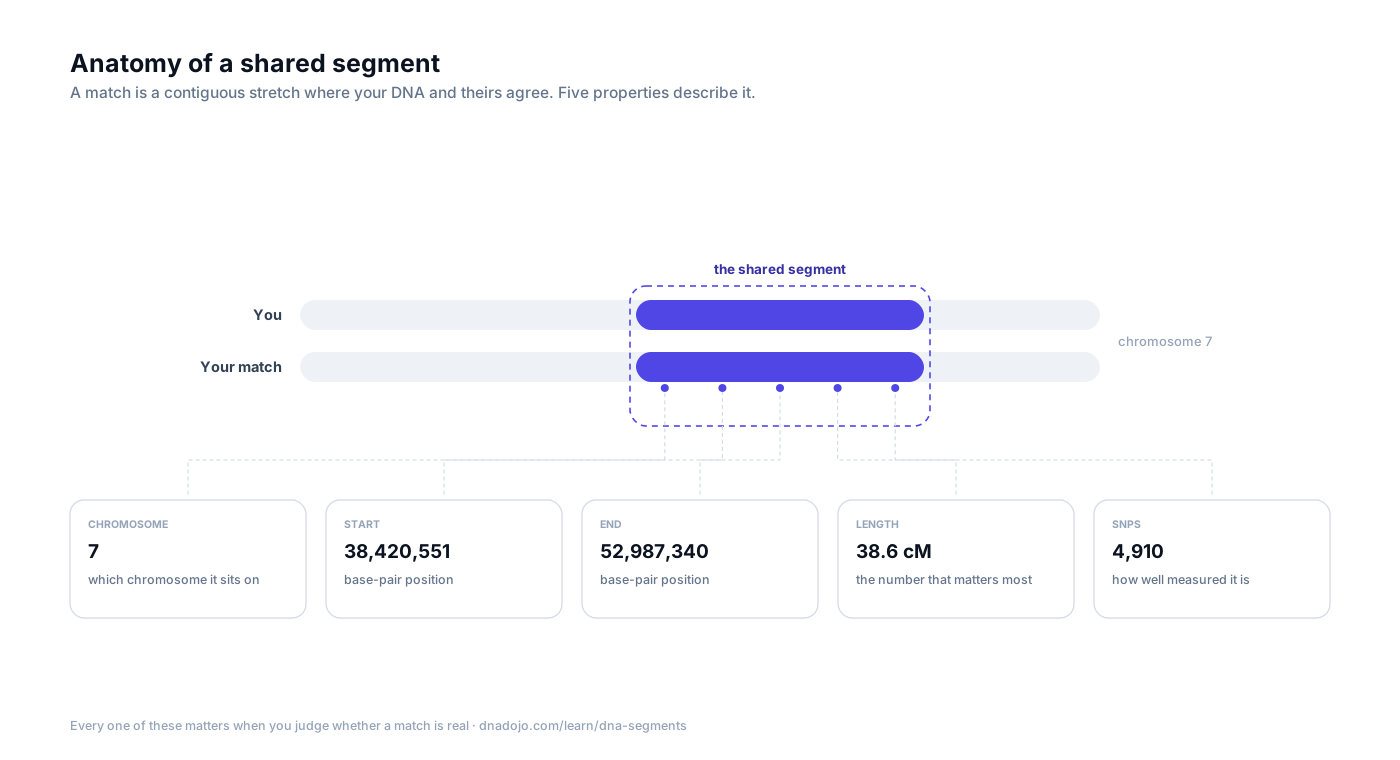
Also distinguish genetic distance from physical length. Centimorgans estimate how often recombination occurs across a region; base pairs count physical positions in the DNA sequence. The same number of base pairs can represent a different number of cM in another part of the genome. For relationship research, preserve the value and unit exactly as the provider presents them, along with the test name and date you recorded it.
Use the segment as evidence, not as a shortcut
Start with a candidate relationship from the total shared cM, then ask whether the longest segment and segment count make that candidate more or less coherent. Next, inspect shared matches. If several independently documented relatives connect through the same ancestral couple, that cluster gives the segment a family-tree context that the measurement cannot supply on its own. Where chromosome-browser data are available, overlapping coordinates can support a segment investigation, but a shared-match list alone is not proof that everyone shares the same segment.
Short segments require particular restraint. Some reflect a genuine distant ancestor; others may be identical by population rather than inherited through the recent tree you are researching, and some may be matching noise near a platform’s threshold. Endogamy, pedigree collapse, and multiple lines of relationship can produce many segments through more than one ancestral path. In those settings, a large total assembled from numerous modest segments can make a match appear genealogically closer than any single path really is.
Know the limit of the conclusion
A longest segment can strengthen or weaken a genealogy hypothesis, but it does not establish parentage, prove a legal relationship, or answer a health question. Even an apparently clear pattern needs ages, records, and match-network evidence before you attach a person to a tree. If the result is unexpected, keep the language provisional and consider the privacy of the tester and their relatives before asking others to test or making contact.
What else could fit?
| Possibility | Why it can look similar | What to check |
|---|---|---|
| One substantial segment | A long intact block has usually passed through fewer recombination events than a short block, so a recent shared line deserves investigation. | Compare total cM and ages, then locate documented shared matches on the proposed branch. |
| Many modest segments | Several pieces can create a meaningful total without any one piece carrying enough information to identify a recent relationship. | Review segment count, provider thresholds, and whether the cluster traces through more than one ancestral path. |
| Endogamous or repeated ancestry | DNA may arrive through multiple distant lines, accumulating a larger total and a dense match network that a single-path chart does not model. | Map every known connection, prioritize well-supported longer segments, and corroborate the branch with records. |
What to do next
- Record the total shared cM, longest segment, segment count, provider, and retrieval date before labels or displays change.
- Run the total through the Shared cM Calculator, keep every compatible relationship, and use ages plus the longest-segment pattern to rank questions—not people.
- Assign the match to a branch only after multiple shared matches or records support the same ancestral path; document alternate paths when endogamy or pedigree collapse is possible.
Questions people ask
Does a long DNA segment prove that a match is a close relative?
No. A long segment can support a more recent shared-ancestor hypothesis, but different relationships overlap. Total cM, ages, shared matches, and records are still needed.
Why can two matches with the same total cM have different longest segments?
Recombination distributes inherited DNA differently in every transmission. One person’s total may be concentrated in a few large pieces, while another person’s equal total is divided among more, smaller pieces.
Can I compare longest-segment values from different DNA companies directly?
Only with caution. Providers can use different genetic maps, segment thresholds, phasing, and filtering rules, so preserve the company and reporting method with every value.
Published September 16, 2026 · Reviewed against DNADojo dataset v1.0.0-simulated · Sources and limitations