Match research
Shared DNA matches: how to place a match on your family tree
A careful workflow for using shared DNA matches to identify a family branch while accounting for platform thresholds, endogamy, and incomplete trees.
Updated 2026-09-13 · 6 min read · Genealogy & education only
Start with what the list actually establishes
Suppose Maya matches you and appears on your match page with Jordan. The display reports pairwise connections under that company’s rules. It does not establish that everyone shares the same stretch of DNA or inherited it through one common ancestor. That stronger claim requires segment evidence and a family-tree explanation.
Shared matches are a map, not a relationship verdict. If an unknown match shares several documented relatives from one grandparent line, the person may belong around that line. The group could still connect through different ancestors, multiple family paths, or relationships absent from the visible trees.
Build anchors before naming the unknown match
Begin with matches whose family placement is supported by records, not merely a platform label. A known first cousin on your maternal grandfather’s side is useful because the paper path identifies the branch; a surname in a small online tree is only a clue. Label each anchor with the ancestral couple or branch you can document.
Record which anchors recur for the unknown person. Two independently documented relatives descending through different children of the same ancestral couple provide a useful pattern. A tested parent who also matches can place the person on that parent’s side. An absent parental match is harder to read because thresholds, privacy settings, or chance inheritance affect what appears.
Turn a cluster into a testable tree hypothesis
Compare the unknown match’s age range, total shared centimorgans, and tree locations with every plausible path on the indicated branch. A 200 cM match should not receive one cousin label solely because cluster members share a surname. Use the total to create a shortlist, then test generations, geography, and documented descendants.
Seek evidence that separates candidates. A relative from only one of an ancestral couple’s later family lines may distinguish which spouse carried the connection. Birth, marriage, adoption, migration, and name-change records can explain a path DNA cannot. Keep observations, interpretations, and conflicts separate so a promising cluster does not become a claimed fact.
Know when a neat cluster can mislead
Companies use different minimum cM thresholds and display rules. A missing person may share less DNA than the display threshold or may have disabled matching. Lists from different companies are neither complete nor directly interchangeable. Save the reported totals, platform, and retrieval date because screens can change.
Endogamy and pedigree collapse need additional caution. In an endogamous community, many people may match through several distant ancestral paths, producing dense clusters that do not isolate one recent couple. Pedigree collapse can put the same ancestor in multiple positions in a smaller family tree. In either situation, map every documented path, give more weight to well-supported recent relatives and substantial segments, and avoid treating cluster size as proof of closeness.
Shared matches and triangulation answer different questions
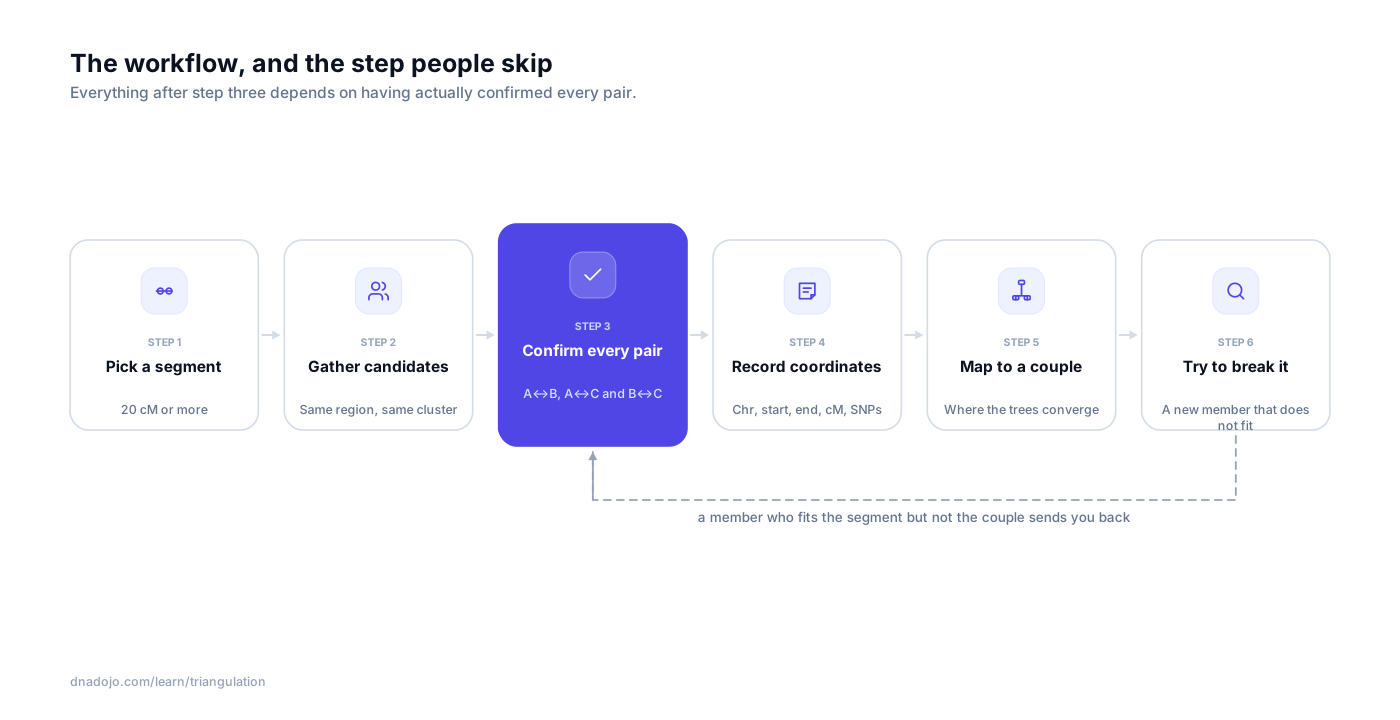
A shared-match cluster asks who is connected to whom. Triangulation asks whether at least three people match one another on the same chromosomal segment. Some platforms do not provide segment coordinates, so clustering may be the most detailed analysis available there. Where coordinates do exist, an overlapping segment can strengthen a branch hypothesis, but it still does not identify the exact ancestor without trees and records.
Treat any unexpected close connection with privacy and restraint. DNA can reveal information about people who did not test. Ask permission before involving relatives, use neutral language in outreach, and do not present a genealogy hypothesis as a clinical, legal, forensic, or definitive parentage conclusion.
What else could fit?
| Possibility | Why it can look similar | What to check |
|---|---|---|
| Known cousin anchor | A documented cousin connects the match network to a named branch rather than to a platform prediction alone. | Verify the cousin’s paper trail to the shared ancestral couple and confirm the reported DNA match. |
| Repeated branch cluster | Several independently placed descendants recurring together make a branch assignment more coherent than any single overlap. | Confirm that the anchors descend through separate lines, then test ages and cM against every plausible relationship path. |
| Dense endogamous cluster | Multiple ancestral paths can cause many people to match one another without isolating one recent couple or one relationship. | Draw all known paths, inspect segment evidence where available, and require records before narrowing the branch. |
What to do next
- Create an anchor table with each known match’s cM total, tested platform, documented branch, supporting records, and retrieval date.
- For the unknown match, mark every recurring anchor and use the Shared cM Calculator to retain all relationship paths compatible with the total and generation gap.
- Test the leading branch against records, ages, locations, and segment data where available; record conflicts and keep the conclusion provisional until independent evidence agrees.
Questions people ask
Does a shared DNA match mean that all three people share the same ancestor?
No. A shared-match display shows a network of pairwise DNA matches under that platform’s rules. The people may connect through different ancestors or through multiple paths, so trees and other evidence are needed.
Why does a known relative not appear in my shared-match list?
The relative may fall below the company’s shared-match display threshold, may have changed privacy or matching settings, or may not have inherited enough of the relevant DNA. Check the platform’s current rules before interpreting the absence.
Are shared matches the same thing as DNA triangulation?
No. Shared matches describe a match network. Triangulation requires three or more people to match one another on the same overlapping chromosomal segment, and even triangulation still needs family-tree evidence to identify an ancestor.
Published September 17, 2026 · Reviewed against DNADojo dataset v1.0.0-simulated · Sources and limitations