Match research
How DNA sites estimate relationship ranges
Why consumer DNA services can label the same match differently, what their estimates actually use, and how to turn a label into a responsible research question.
Updated 2026-09-13 · 6 min read · Genealogy & education only
A relationship label is a compressed range
When a site calls a person a “close family” match or suggests a cousin range, it is translating a distribution of observed DNA sharing into a readable phrase. It is not reading names from your chromosomes. The same amount of shared DNA can be produced by several tree paths because recombination gives each pair of relatives a different inheritance outcome.
That is why a label can be useful and still be incomplete. A first cousin, half aunt, great-aunt, or first cousin once removed can overlap in cM. The label identifies a neighbourhood of relationships; the rest of the evidence identifies the address.
Why estimates vary by provider
Providers can differ in how they phase data, which segments they report, the minimum segment threshold, the genetic map used to measure distance, and whether they exclude regions that produce many low-information matches. Some also choose broad labels to avoid implying more precision than the data supports. A small difference in reported cM may be normal rather than a contradiction.
Tree context matters too, even when a platform does not use it directly. Your age, the age of the match, known maternal or paternal relatives, and the match’s shared-match cluster may rule out an otherwise compatible estimate. No automated label has access to every adoption, name change, migration, or unrecorded relationship in a family.
Read the estimate as a research plan
Start by recording the exact cM total and any segment information. Use the Shared cM Calculator to see the compatible relationships rather than anchoring on one provider label. Then ask the facts that have separating power: Are you in the same generation? Which known relatives match? Does the person sit in one maternal or paternal cluster? Is the proposed tree path documented?
For an unexpected close match, take care with language and timing. A relationship estimate can reveal a biological possibility without explaining family circumstances. Preserve the data, seek independent evidence, and do not use a consumer estimate as a legal, forensic, medical, or definitive parentage conclusion.
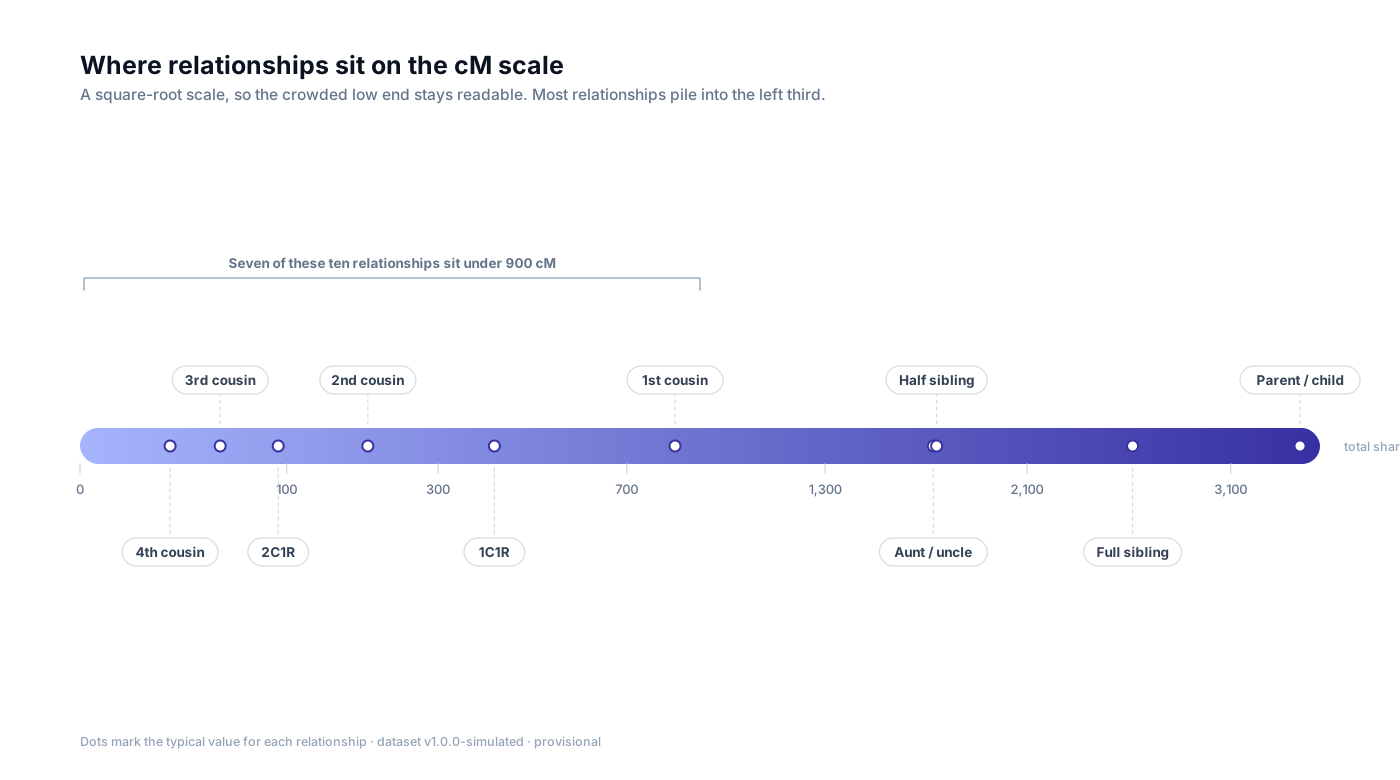
What else could fit?
| Possibility | Why it can look similar | What to check |
|---|---|---|
| Provider relationship label | It makes a broad range easier to read, but it is based on a limited set of matching signals and product rules. | Treat it as a candidate and compare the underlying total cM with other compatible family paths. |
| Reported shared cM total | It is the central numeric evidence used by most relationship estimates, although ranges overlap. | Record the provider and date, then use age, segments, and shared matches to narrow the shortlist. |
| Documented tree relationship | A verified tree explains how two people connect, which DNA alone generally cannot identify. | Confirm records and test whether the expected match network agrees with the proposed path. |
What to do next
- Save the site’s reported cM total, segment count or longest segment when available, platform name, and date.
- Run the total through a range calculator and write down every relationship that remains compatible with the age gap.
- Use shared matches and documentary evidence to test the paths; update the hypothesis when a fact conflicts rather than forcing the platform label to fit.
Questions people ask
Why does one DNA company call my match a cousin while another calls them a close relative?
Companies can use different maps, thresholds, segment rules, and label ranges. The same underlying relationship can therefore receive different consumer-facing descriptions.
Does a DNA relationship estimate prove that someone is my first cousin?
No. A label indicates compatibility with a range of relationships. A first-cousin conclusion needs family-tree, age, shared-match, and often additional DNA evidence.
Which number should I save from a DNA match page?
Save the total shared cM first, plus the provider, date, and available segment details. Those facts remain useful even when a platform later changes its label.
Published September 17, 2026 · Reviewed against DNADojo dataset v1.0.0-simulated · Sources and limitations