Free calculator
Shared cM Calculator
Enter the centimorgans you share with a DNA match and see every relationship that fits, ranked by how well it matches — with the uncertainty shown honestly rather than hidden.
Shared centimorgans
Deterministic · no AIHow to read this result
The ranking is a relative compatibility score, not a probability that you are actually related in a given way. It answers one narrow question: given this amount of shared DNA and nothing else, which relationships sit closest to their expected value? It knows nothing about your ages, your surnames, your tree, or which side of the family the match is on — all of which are usually stronger evidence than the cM number itself.
Turning a shortlist into an answer
- Check the ages. A 25-year gap usually eliminates half the shortlist immediately.
- Check the side. If the match also shares DNA with a known maternal relative, every paternal option disappears.
- Look at the segments. One long segment points to a closer, more recent connection than the same total split across many small ones.
- Look at shared matches. The cluster a match falls into is often more informative than their cM value.
- Go back to the paper trail. DNA narrows the hypothesis; records confirm it.
Reference ranges
The full table behind the calculator. Every row carries the dataset version it came from, and every row is currently marked provisional.
| Relationship | Expected | Typical cM | Range |
|---|---|---|---|
| Identical twin | 100.00% | 6,900 | 6,700–7,100 |
| Parent / child | 50.00% | 3,485 | 3,485–3,485 |
| Full sibling | 50.00% | 2,594 | 1,916–3,154 |
| Half sibling | 25.00% | 1,718 | 908–2,546 |
| Grandparent / grandchild | 25.00% | 1,733 | 652–2,844 |
| Aunt/uncle — niece/nephew | 25.00% | 1,705 | 966–2,447 |
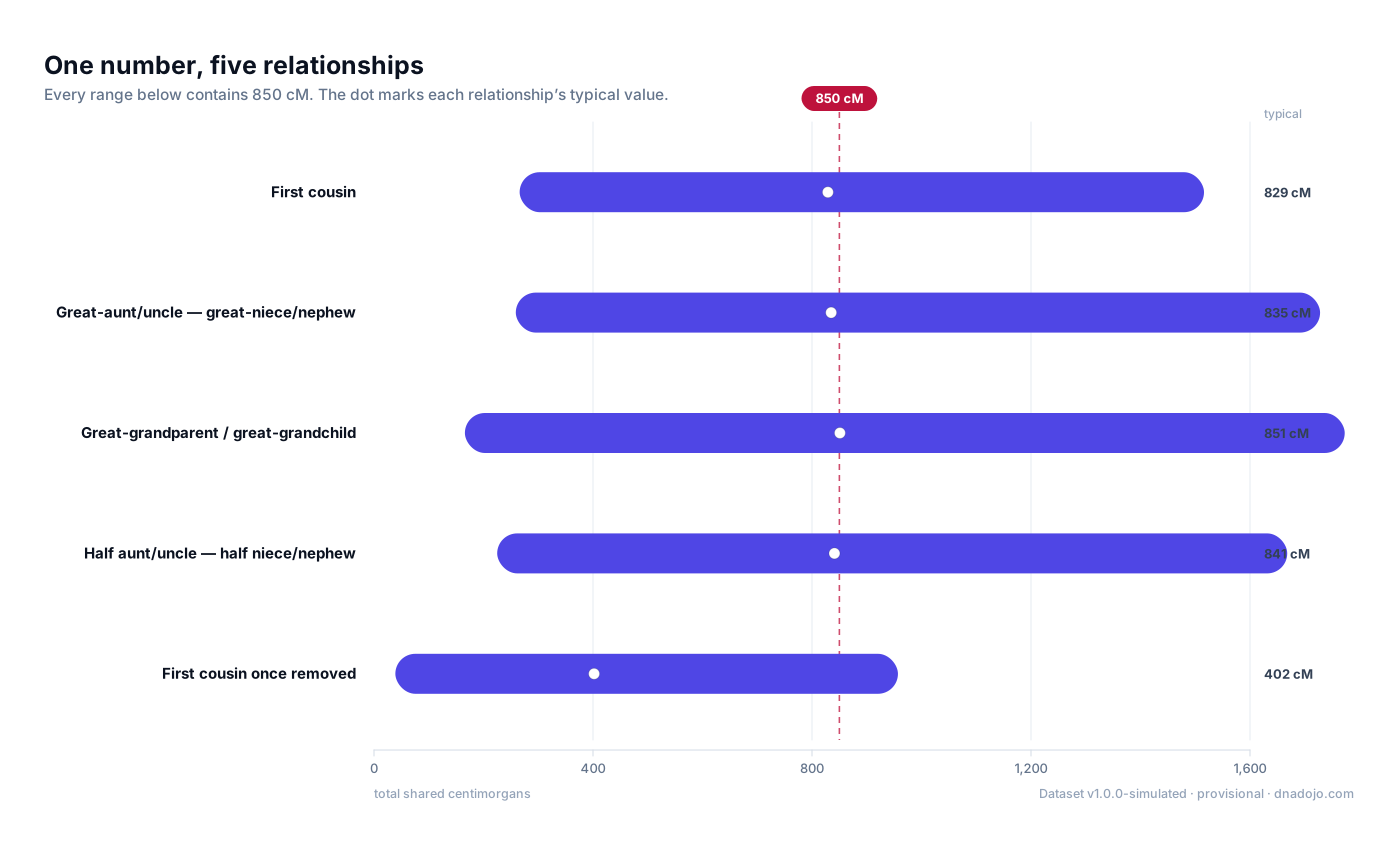
| Half aunt/uncle — half niece/nephew | 12.50% | 841 | 225–1,668 |
| Great-grandparent / great-grandchild | 12.50% | 851 | 166–1,773 |
| Great-aunt/uncle — great-niece/nephew | 12.50% | 835 | 259–1,728 |
| First cousin | 12.50% | 829 | 266–1,516 |
| Half great-aunt/uncle — half great-niece/nephew | 6.25% | 409 | 25–1,074 |
| 2nd great-grandparent / 2nd great-grandchild | 6.25% | 416 | 7–1,196 |
| 2nd great-aunt/uncle — 2nd great-niece/nephew | 6.25% | 406 | 34–1,055 |
| Half first cousin | 6.25% | 409 | 23–1,057 |
| First cousin once removed | 6.25% | 402 | 39–957 |
| 3rd great-grandparent / 3rd great-grandchild | 3.13% | 198 | 7–753 |
| Half first cousin once removed | 3.13% | 196 | 7–734 |
| First cousin twice removed | 3.13% | 193 | 7–673 |
| Second cousin | 3.13% | 194 | 7–677 |
| First cousin three times removed | 1.56% | 92 | 7–442 |
| Half second cousin | 1.56% | 93 | 7–462 |
| Second cousin once removed | 1.56% | 92 | 7–443 |
| Half second cousin once removed | 0.781% | 47 | 7–322 |
| Second cousin twice removed | 0.781% | 46 | 7–284 |
| Third cousin | 0.781% | 46 | 7–286 |
| Second cousin three times removed | 0.391% | 27 | 7–223 |
| Half third cousin | 0.391% | 28 | 7–240 |
| Third cousin once removed | 0.391% | 27 | 7–213 |
| Third cousin twice removed | 0.195% | 20 | 7–161 |
| Fourth cousin | 0.195% | 19 | 7–180 |
| Fourth cousin once removed | 0.098% | 16 | 7–133 |
| Fifth cousin | 0.049% | 15 | 7–105 |
| Sixth cousin | 0.012% | 12 | 7–74 |
Common questions
Why does one cM number match so many different relationships?
Because recombination is random. Two people who are second cousins might share 60 cM or 400 cM, and those ranges overlap heavily with half first cousin once removed, first cousin twice removed and several others. A cM value narrows the field; it almost never picks a single answer.
Should I use total shared cM or the longest segment?
Enter total shared cM — the sum of every shared segment reported by your testing company. Longest-segment length is a useful sanity check: a 90 cM total made of one 90 cM segment suggests a closer, more recent connection than a 90 cM total made of nine 10 cM segments.
My match and I share 0 cM but we know we are related. Is that possible?
Yes, and it is common past third cousin. Autosomal DNA is diluted by roughly half each generation, so a documented fourth cousin has a meaningful chance of sharing nothing detectable. No shared DNA disproves nothing on its own.
Does DNADojo store the number I type in?
No. The calculation runs in your browser. Nothing is sent to a server, there is no account, and closing the tab clears it. If you use the share link, the cM value is in the URL — that is the only place it is written down, and it contains no name or identifier.